
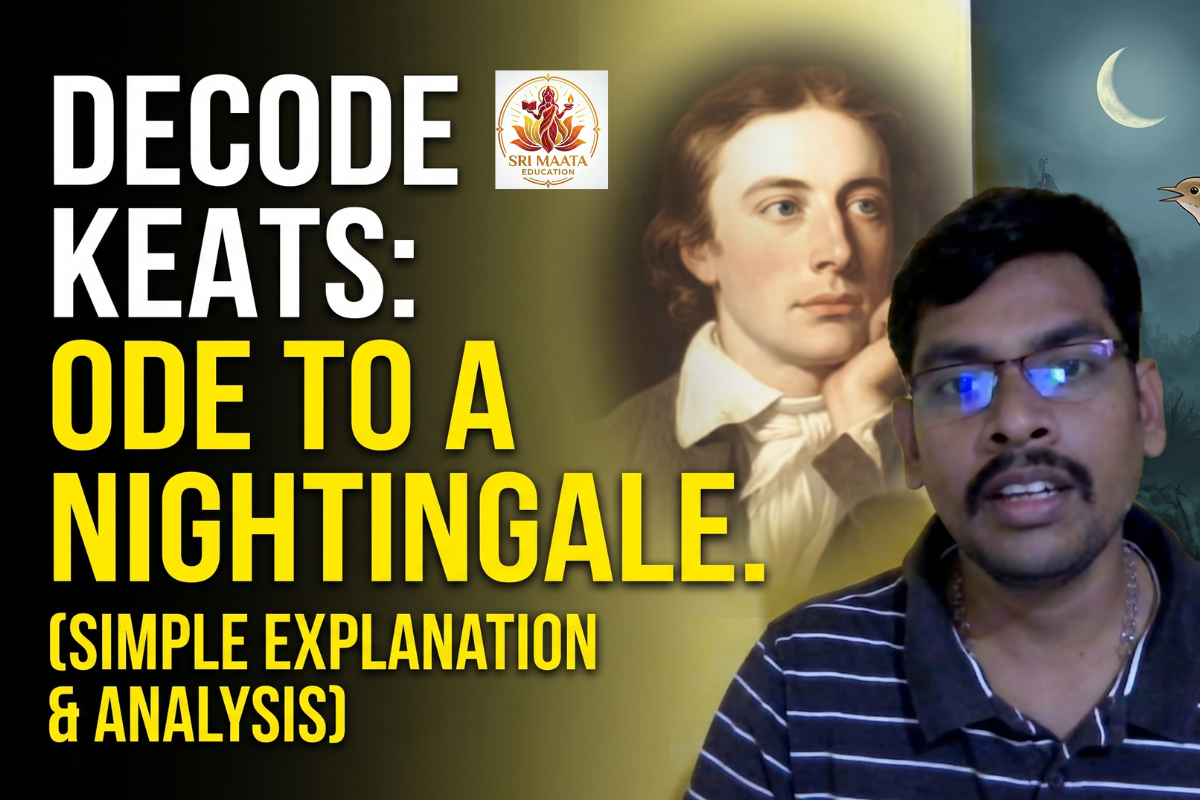
John Keats’s “Ode to a Nightingale” is universally acclaimed as one of the supreme masterpieces of English Romantic poetry. For aspirants of the RGUKT AP Lecturers Exam (English Literature), it is a crucial text that requires deep analytical understanding rather than simple memorization.
This article provides a comprehensive study module designed to decode the poem, placing special emphasis on the elements most relevant to the AP Lecturers curriculum. By analyzing the structural mechanics, historical context, and philosophical core of the ode, you can build the knowledge base necessary to tackle exam questions with confidence.
Part 1: Historical and Biographical Context
The “Annus Mirabilis” of 1819
To understand the emotional depth of the poem, it is essential to place it in its historical context. Keats composed “Ode to a Nightingale” in May 1819, in the garden of Wentworth Place in Hampstead.
This year, known as Keats’ “Annus Mirabilis” (Year of Wonders), was a period of incredible creative output. During this time, he also penned other legendary works, including Ode on a Grecian Urn, Ode on Melancholy, Ode to Psyche, and To Autumn.
The Personal Grief Behind the Ode
The RGUKT exam often tests the intersection of an author’s life and work. In the case of “Ode to a Nightingale,” personal tragedy heavily informed the text. Keats was deeply impacted by the agonizing death of his younger brother, Tom Keats, who succumbed to tuberculosis (then known as “consumption”) in December 1818.
This, combined with his own declining health, his complex and tumultuous romance with Fanny Brawne, and chronic financial worries, significantly shaped the melancholic, escapist, and mortal themes of the ode.
Part 2: Form, Meter, and Structural Analysis
Keats was a meticulous craftsman. A technical analysis of the poem’s structure is a high-yield study area for the lecturer exam.
| Feature | Technical Specification | Relevance for RGUKT Candidates |
| Genre | Horatian / Romantic Ode | Unlike public, celebratory Pindaric odes, Keats’ work has a personal, reflective, and meditative tone. |
| Structure | 8 Stanzas, 10 lines each | The 80-line poem uses a complex stanzaic structure. |
| Rhyme Scheme | A-B-A-B-C-D-E-C-D-E | This scheme is consistent across all eight stanzas and combines Shakespearean (ABAB) and Petrarchan (CDECDE) rhyme elements. |
| Meter | Iambic Pentameter and Trimeter | Key Fact for the Exam: Lines 1–7, 9, and 10 of each stanza are in Iambic Pentameter. Line 8 is Iambic Trimeter (three beats/six syllables). This structural feature slows the rhythm of the poem and is frequently the subject of exam questions. |
Part 3: Comprehensive Stanza-by-Stanza Analysis
This section offers a breakdown of the key concepts and literary figures in each of the poem’s eight stanzas.
Stanza 1: Drowsy Numbness & Excess Joy
“My heart aches, and a drowsy numbness pains / My sense, as though of hemlock I had drunk…”
- Core Theme: The speaker experiences a state of painful ecstasy triggered by the nightingale’s music.
- Literary Allusions: Keats references Hemlock (the poison that killed Socrates), Opium (a “dull opiate”), and Lethe (the river of forgetfulness in the underworld).
- The Key Paradox: The speaker’s ache does not come from envy, but from being “too happy” in the bird’s happiness. This introduces the idea of joy and pain intermingling.
- Literary Device: Synaesthesia is used to blend physical pain with psychological sensation.
Stanza 2: Escapism via Wine (Bacchus)
“O, for a draught of vintage! that hath been / Cool’d a long age in the deep-delved earth…”
- Core Theme: The attempt to use alcohol (sensual intoxication) to escape reality.
- Key Concepts: Keats yearns for wine that tastes of Flora (goddess of flowers), Country green, Dance, Provençal song, and sunburnt mirth.
- Key Allusion: Hippocrene, the fountain of the Muses on Mt. Helicon. He describes its inspiring waters as having “beaded bubbles winking at the brim.”
- The Objective: To “leave the world unseen” and “fade away” into the dim forest with the nightingale.
Stanza 3: Human Suffering & Mortality
“Fade far away, dissolve, and quite forget / What thou among the leaves hast never known, / The weariness, the fever, and the fret…”
- Core Theme: The contrast between the bird’s eternal realm and the harshness of human life.
- Biographical Echo: The lines “Where palsy shakes a few, sad, last gray hairs, / Where youth grows pale, and spectre-thin, and dies” directly reference the death of Tom Keats.
- Philosophical Observation: Human existence is defined by sorrow; to think is to be full of sorrow. Keats notes that Beauty and Love are transient.
Stanza 4: Poesy & Imagination
“Away! away! for I will fly to thee, / Not charioted by Bacchus and his pards, / But on the viewless wings of Poesy…”
- Core Theme: A shift from wine to Poetry (Imagination) as the true vehicle of transport.
- Literary Allusion: He explicitly rejects Bacchus (god of wine) and his pards (leopards that pull his chariot).
- Key Concept: “The viewless wings of Poesy” refers to the invisible power of poetry.
- Atmosphere: He mentally joins the Queen-Moon, though his physical reality remains “tender is the night.”
Stanza 5: Synaesthetic Darkness
“I cannot see what flowers are at my feet, / Nor what soft incense hangs upon the boughs…”
- Core Theme: Sensory perception in total darkness (“Embalmed darkness”).
- Literary Device: The master of Synaesthesia, Keats smells and “guesses” flowers he cannot see: white hawthorn, pastoral eglantine, fast fading violets, and the musk-rose (described as “the murmurous haunt of flies on summer eves”).
Stanza 6: Half-Love with Easeful Death
“Darkling I listen; and, for many a time / I have been half in love with easeful Death…”
- Core Theme: The morbid romanticization of death.
- Key Idea: Keats explores dying without pain in the dark, while the nightingale is in “such an ecstasy.”
- The Realization: If he dies, he will become a “sod” (earth/dirt), but the bird will continue its “immortal” song. This highlights the irony of human death versus the immortality of nature/art.
Stanza 7: The Immortality of the Nightingale
“Thou wast not born for death, immortal Bird! / No hungry generations tread thee down…”
- Core Theme: The immortality of art/nature contrasted with the mortality of individual human existence. The bird itself is mortal, but its song is eternal.
- Historical/Biblical Parallel: He traces the song back, noting it was heard by ancient emperors, clowns, and the biblical figure Ruth, who stood weeping “amid the alien corn.”
- Fairyland Allusion: The song opened “magic casements” in “faery lands forlorn.”
Stanza 8: The Return to Reality
“Forlorn! the very word is like a bell / To toll me back from thee to my sole self! / Adieu! the fancy cannot cheat so well…”
- Core Theme: Disenchantment and the inevitable return to self-awareness.
- The Trigger Word: The word “Forlorn” functions like a bell, pulling him from imagination back to his “sole self.”
- Keatsian Philosophy: Imagination is called a “deceiving elf.” He rejects the ability of “fancy” (imagination) to permanently overcome reality.
- Ending Ambiguity: “Was it a vision, or a waking dream? / Fled is that music:—Do I wake or sleep?” The poem ends with a profound question about the nature of reality and perceived experience.
Part 4: Core Themes and Philosophical Concepts
Beyond the stanza-by-stanza breakdown, candidates must grasp the overarching philosophical concepts Keats weaves into the ode. These are likely areas for analytical questions.
Negative Capability
Keats defined Negative Capability in his letters as the ability to be in “uncertainties, Mysteries, doubts, without any irritable reaching after fact & reason.”
In “Ode to a Nightingale,” this concept is in full view. Keats rejects wine and rational analysis to merge fully with the nightingale’s song, accepting a state of being where logical, “fact-based” thinking is surrendered for the sake of an intense experience of beauty.
Mortality vs. Immortality
This is the primary conflict in the poem. The individual nightingale is mortal, but the song of the nightingale represents eternal, timeless beauty that survives across generations. In contrast, individual human experience is inherently defined by transience. Youth, passion, and beauty will inevitably “pine beyond tomorrow,” a hard truth Keats was acutely aware of.
Escapism and its Limits
Keats explores three methods of escaping human suffering:
- Wine (intoxication, rejected as transient)
- Poetry/Imagination (rejected as a “deceiving elf” that cannot last)
- Death (rejected as final and resulting in a loss of the very experience he seeks)
Ultimately, the poem teaches that while the imagination is a powerful tool, it cannot permanently overcome the harsh reality of the human condition.
Part 5: Exam Practice Questions
Test your knowledge with these practice questions modeled after the RGUKT AP Lecturers Exam format.
1. Which line in each stanza of ‘Ode to a Nightingale’ is written in iambic trimeter? A) Line 6 B) Line 8 C) Line 10 D) Line 4
Answer: B) Line 8
2. The phrase “Blushful Hippocrene” in Stanza 2 refers to: A) A fountain sacred to the Muses on Mt. Helicon B) A type of French wine C) A river in the underworld D) The goddess of flowers
Answer: A) A fountain sacred to the Muses
3. Which biblical figure is explicitly mentioned in Stanza 7 of the poem? A) Mary B) Ruth C) Esther D) Rachel
Answer: B) Ruth
4. What causes the speaker to break his imaginative spell and return to reality in Stanza 8? A) The fading of the moon B) The word “Forlorn” C) The morning sun D) The departure of the bird
Answer: B) The word “Forlorn”
5. “Where youth grows pale, and spectre-thin, and dies” directly reflects Keats’s personal grief over the death of: A) His mother Frances B) His brother Tom C) His father Thomas D) Percy Bysshe Shelley
Answer: B) His brother Tom