
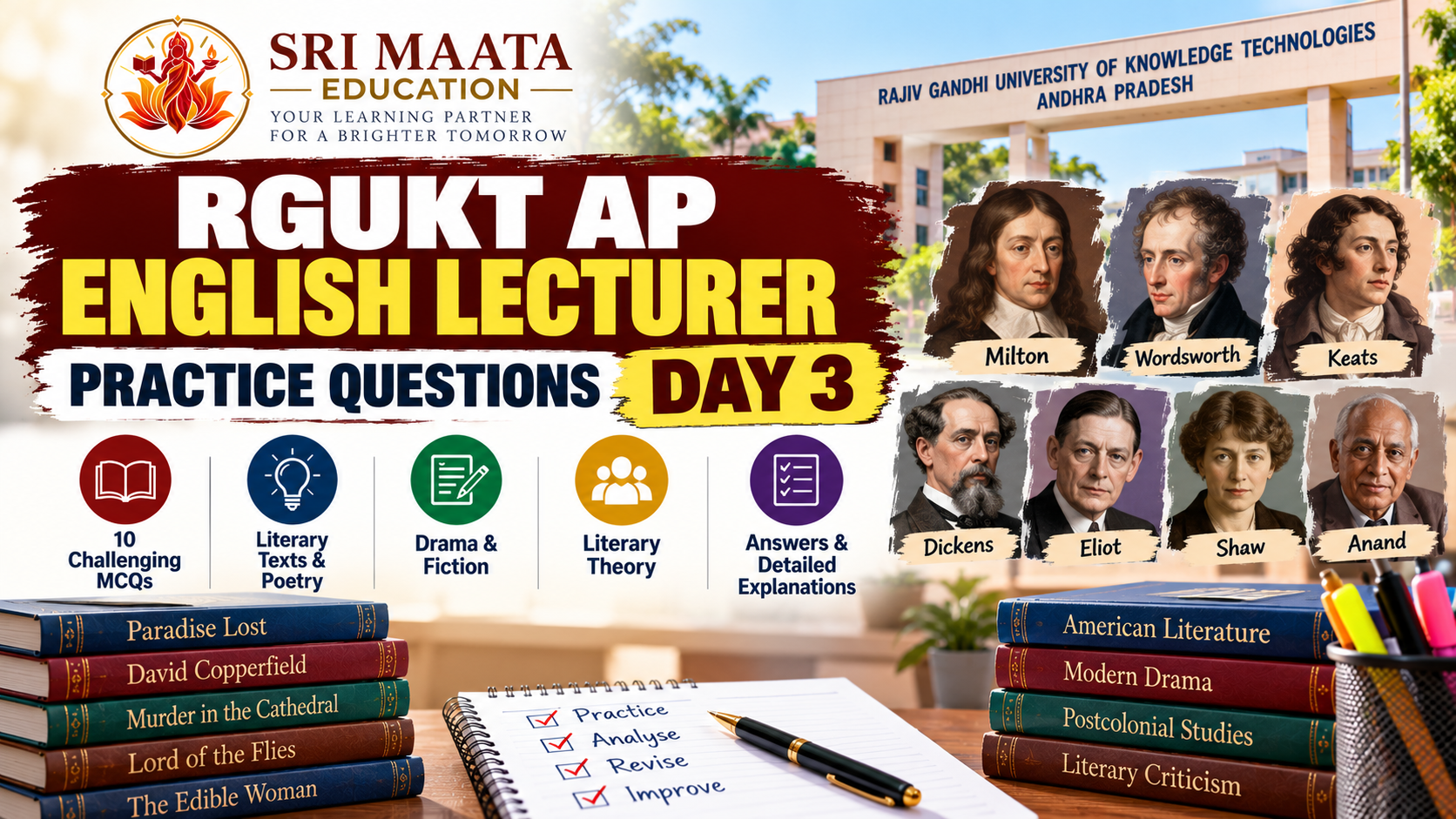
Welcome to Day 3 of the Sri Maata Education RGUKT AP English Lecturer Daily Challenge.
Today’s practice set concentrates on prescribed literary texts, with special attention to conceptual understanding and interpretation. It includes eight standard multiple-choice questions, one assertion–reasoning question and one match-the-following question.
Suggested time: 15 minutes. Attempt every question before checking the explanations.
Day 3 Practice Questions
Question 1: John Milton – Paradise Lost, Book I
In Paradise Lost, Book I, Satan’s declaration that the mind can transform its experience of Heaven and Hell primarily reveals:
A. Milton’s endorsement of Satan’s philosophy of absolute mental freedom.
B. Satan’s attempt to maintain an illusion of autonomy despite his actual defeat.
C. Satan’s acceptance of divine authority as morally superior.
D. The narrator’s denial that Hell possesses any objective existence.
Correct Answer: B
Explanation: Satan’s assertion of mental independence expresses his defiant self-fashioning after defeat. Yet his claim cannot erase his actual condition or the moral consequences of rebellion. Milton allows Satan to sound rhetorically powerful while exposing the limitations and self-deception underlying his argument. Candidates should distinguish Satan’s perspective from the poem’s larger moral framework.
Question 2: William Wordsworth – Immortality Ode
The movement of Wordsworth’s Ode: Intimations of Immortality is best described as a transition from:
A. Religious certainty to complete philosophical scepticism.
B. Childhood’s visionary perception to mature consolation through memory and human sympathy.
C. Sensory pleasure to the rejection of all natural experience.
D. Individual memory to an exclusively political understanding of history.
Correct Answer: B
Explanation: The poem begins with the speaker’s awareness that childhood’s visionary splendour has diminished. Although the earlier perception cannot be fully recovered, the poem finds compensation in memory, human sympathy and mature reflection. The loss is acknowledged rather than simply reversed.
Question 3: John Keats – To Autumn
The three-stanza structure of To Autumn is particularly significant because it:
A. Presents a conventional argument for the superiority of spring over autumn.
B. Moves from abundance through personified seasonal activity towards the sounds of approaching decline.
C. Develops an explicit rejection of sensuous experience in favour of abstract philosophy.
D. Uses autumn exclusively as an allegory for political revolution.
Correct Answer: B
Explanation: The first stanza emphasises ripeness and abundance. The second personifies Autumn through figures engaged in harvesting and related activities. The final stanza turns towards the season’s own music as daylight fades. This progression allows Keats to recognise transience without reducing autumn to a symbol of loss.
Question 4: Charles Dickens – David Copperfield
Which interpretation best explains the function of retrospective first-person narration in David Copperfield?
A. It eliminates the difference between the child’s immediate perceptions and the adult narrator’s understanding.
B. It allows the adult David to reconstruct childhood experiences while exposing the distance between earlier perception and later judgement.
C. It guarantees that every event is presented without emotional bias.
D. It prevents the novel from exploring the development of personal identity.
Correct Answer: B
Explanation: David Copperfield is narrated retrospectively. The adult David recounts experiences that his younger self did not always fully understand. This creates a productive relationship between remembered experience and later interpretation, contributing to the novel’s treatment of personal growth and self-knowledge.
Question 5: T. S. Eliot – Murder in the Cathedral
Assertion (A): Thomas Becket’s final temptation in Murder in the Cathedral concerns the possibility of seeking martyrdom for personal spiritual glory.
Reason (R): The play distinguishes genuinely selfless sacrifice from an action outwardly religious but inwardly motivated by pride.
Choose the correct answer.
A. Both A and R are true, and R correctly explains A.
B. Both A and R are true, but R does not explain A.
C. A is true, but R is false.
D. A is false, but R is true.
Correct Answer: A
Explanation: The fourth tempter presents Becket with the possibility of desiring martyrdom for the glory associated with becoming a saint. This is more subtle than the earlier temptations because it turns an apparently holy outcome into a possible expression of pride. Becket must therefore examine the motive behind his willingness to die. The reason directly explains the assertion.
Question 6: G. B. Shaw – Saint Joan
Shaw’s treatment of Joan’s trial in Saint Joan is most accurately understood as:
A. A simple opposition between an entirely enlightened heroine and uniformly irrational opponents.
B. A dramatic examination of the conflict between individual conviction and established religious and political institutions.
C. A rejection of Joan’s historical significance in favour of romantic comedy.
D. An argument that institutional authorities possessed no intelligible motives for opposing Joan.
Correct Answer: B
Explanation: Shaw gives institutional representatives arguments rooted in their understanding of political order, religious authority and social stability. Joan’s personal conviction challenges these structures. The dramatic conflict is therefore more complex than a straightforward confrontation between goodness and evil.
Question 7: William Golding – Lord of the Flies
The transformation of the boys’ fear of the beast in Lord of the Flies most strongly supports which interpretation?
A. Evil exists only as an external creature that the boys fail to capture.
B. The beast becomes a projection of the destructive impulses within the boys themselves.
C. Fear disappears once the boys establish an organised system of leadership.
D. The novel presents civilisation as an automatic guarantee of moral conduct.
Correct Answer: B
Explanation: The boys increasingly attribute their fears to an external beast, but Simon’s insight points towards the violence and disorder within human beings. Golding uses the beast to explore the fragility of civilisation and the capacity for cruelty within the group.
Question 8: Robert Frost – Home Burial
The conflict between the husband and wife in Home Burial is intensified primarily by:
A. Their agreement that grief should remain completely unexpressed.
B. Their contrasting ways of expressing grief and their inability to interpret each other’s responses.
C. The husband’s complete indifference to the death of their child.
D. The wife’s refusal to acknowledge that the child has died.
Correct Answer: B
Explanation: The poem dramatises a breakdown in communication between two grieving parents. The husband seeks verbal exchange and practical continuity, while the wife experiences his behaviour as a failure to understand her loss. Their conflicting expressions of grief create emotional distance. The poem does not establish that the husband feels no sorrow.
Question 9: Mulk Raj Anand – Untouchable
Bakha’s experiences in Untouchable are most effectively interpreted as exposing:
A. The social and psychological effects of caste-based exclusion upon an individual’s everyday life.
B. The disappearance of caste distinctions in colonial Indian society.
C. The idea that personal cleanliness automatically eliminates social discrimination.
D. The complete resolution of caste oppression through Bakha’s individual efforts.
Correct Answer: A
Explanation: Anand depicts how caste discrimination governs Bakha’s movements, interactions, labour and sense of self. The novel contrasts his personal dignity and aspirations with a social order that treats him as impure. Its conclusion introduces possible responses to untouchability without presenting a simple, completed resolution.
Question 10: Margaret Atwood – The Edible Woman
Match the following elements of The Edible Woman with their most appropriate interpretations.
List I
- Marian’s inability to eat certain foods
- The woman-shaped cake
- The shift from first-person to third-person narration
- Consumer culture and advertising
List II
P. The treatment of identity and desire through commodification
Q. A formal representation of estrangement from the self
R. Bodily resistance to prescribed social expectations
S. A symbolic confrontation with the image of femininity imposed upon Marian
A. 1–R, 2–S, 3–Q, 4–P
B. 1–S, 2–R, 3–P, 4–Q
C. 1–Q, 2–P, 3–R, 4–S
D. 1–P, 2–Q, 3–S, 4–R
Correct Answer: A
Explanation: Marian’s difficulty eating can be interpreted as bodily resistance to the expectations surrounding her. The woman-shaped cake externalises the image of femininity she is expected to inhabit. The movement into third-person narration reflects her alienation from her own experience, while the novel’s attention to advertising and consumption explores the commodification of identity.
Day 3 Answer Key
| Question | Answer | Prescribed work |
|---|---|---|
| 1 | B | Paradise Lost, Book I |
| 2 | B | Immortality Ode |
| 3 | B | To Autumn |
| 4 | B | David Copperfield |
| 5 | A | Murder in the Cathedral |
| 6 | B | Saint Joan |
| 7 | B | Lord of the Flies |
| 8 | B | Home Burial |
| 9 | A | Untouchable |
| 10 | A | The Edible Woman |
Day 3 Revision Strategy
If you answered fewer than eight questions correctly, revisit the prescribed texts and identify the exact literary technique, thematic conflict or character development being tested.
For the assertion–reasoning question, establish whether each statement is independently true before determining whether the reason explains the assertion.
For match-the-following questions, first identify the strongest conceptual pairings, then eliminate inconsistent combinations.
The score target is only a Sri Maata Education practice benchmark, not an official RGUKT qualifying standard.
Download Day 3 Practice PDF
The free PDF contains all 10 questions, answer options, the complete answer key and detailed explanations for offline revision.
Sri Maata Education Daily Challenge is an independent examination-preparation initiative. These are original practice questions based on the prescribed English syllabus (Subject Code 90), not official RGUKT questions or predictions of the examination paper.